
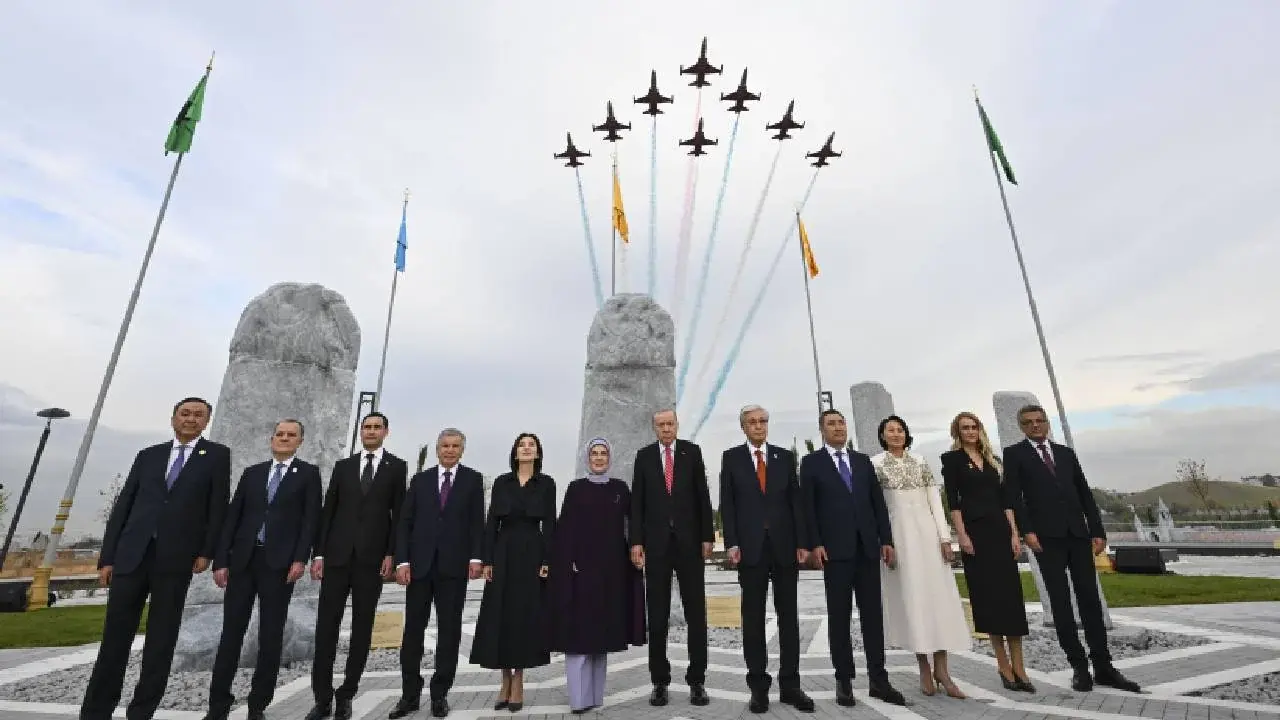
Behind the crisis that erupted on the Baku–Ankara axis over a dress code lie issues that have been building up for years. Aliyev’s last-minute decision not to visit Ankara serves as a message to the Erdoğan administration. The issue is neither the dress code nor relations with Israel. Despite the rhetoric of ‘one nation, two states’, the two regimes are heading in different directions. Whilst Turkey is steering towards the Middle East, Azerbaijan is heading westwards.
- Bağımsız gazetecilik bir tık kadar yakınUygulamamızı indirin, en güncel haberler…
- Uygulamamızı indirin, en güncel haberler cebinize gelsin…
- Özel haberlerimizi ve günün öne çıkan gelişmelerini kaçırmamak için BirGün’ün Wh…
Detaylar ve Resmi Açıklamalar
Bağımsız gazetecilik bir tık kadar yakınUygulamamızı indirin, en güncel haberler cebinize gelsin
Uygulamamızı indirin, en güncel haberler cebinize gelsin
Özel haberlerimizi ve günün öne çıkan gelişmelerini kaçırmamak için BirGün’ün WhatsApp kanalını buraya dokunarak hemen takibe alabilirsiniz.
İbrahim VarlıAlthough the crisis between Azerbaijan and Turkey, which has been simmering for some time, erupted over the dress code, the causes of the tension between the two countries run too deep to be brushed aside by blaming a few trolls, politicians or advisers.The fact that Azerbaijani leader Ilham Aliyev has decided not to attend today’s Turkic States Organisation Summit in Ankara highlights the scale of the crisis. According to Azerbaijani media, Aliyev’s reason for not attending is his heavy workload.Although attempts are being made to bring it under control, the crisis marks a turning point in that it has created the first serious crack in the ‘one nation, two states’ thesis. The fact that the Presidential Palace has, under pressure from Aliyev’s administration, sacrificed its own chief adviser in an unprecedented manner is an indication of the seriousness of the matter.Following mutual accusations, allegations and confrontations, the Aliyev administration took its displeasure as far as publishing a “list of bans” and demanding the removal of figures from the AKP. The Azerbaijani leader did not stop there; despite Erdoğan calling him personally, he declined to visit Ankara. Even the intervention of MHP leader Devlet Bahçeli failed to ease the tension. AKP MP Kürşad Zorlu had announced a few days earlier that Aliyev would be coming.THE TIP OF THE ICEBERGAs has been reported for days, the apparent reason – the tip of the iceberg – is Baku’s implementation of a dress code in schools. The regulation banning secondary school girls from wearing the ‘headscarf’ has upset certain religious, reactionary and conservative sections of Turkish society.Azerbaijani journalist Nigar İbrahimova emphasises that the crisis is not a ‘headscarf’ crisis, but rather the eruption of long-simmering tensions.According to İbrahimova, who points out that everyone expected these accumulated tensions to erupt one day, somewhere, for various reasons, the objection to the regulation was the final straw that broke the camel’s back.Taleh Şahsuvarlı, Editor-in-Chief of the AzNews website, also stated that it is impossible to deny that serious tensions exist, noting that the recent crisis was fuelled by ‘political Islamists’ and Sharia-oriented groups in Turkey attacking Azerbaijan by using the headscarf issue in schools and relations with Israel as pretexts.However, according to Şahsuvarlı, all of this is merely the tip of the iceberg. There are many other factors behind the events that have taken place.Aydın Ünal, Erdoğan’s former speechwriter at Yeni Şafak, also argued that the tension cannot be explained solely by the headscarf debate.ONE NATION, TWO STATES, DIFFERENT DIRECTIONSThe issue is neither merely a matter of dress code regulations nor, as claimed, relations with Israel.Although Turkic nationalist, nationalist and right-wing conservative circles espouse the ‘one state, two nations’ rhetoric, for quite some time now the two regimes have been heading in different directions.Whilst Turkey is steering towards the Middle East, Azerbaijan is pursuing integration with the West. Azerbaijan, with its secular government, is concerned about attempts by various religious orders and communities to infiltrate the country from Turkey. Although these attempts have been repelled at various times, the plans of these orders, communities and political Islamists to infiltrate this oil-rich country in the Caucasus have not ceased.Azerbaijan’s positioning on a secular-liberal trajectory is also in line with the orientations of the US and the West. As a guarantor in the Caucasus, close cooperation has been established with this oil-rich nation of ten million people by all global actors.Despite all its dependent relationships, the political Islamist regime in Turkey does not constitute a guarantee in the eyes of global powers. Conjunctural ‘utilisation’ does not replace strategic cooperation.Last week, Kürşad Zorlu, Deputy Chairman of the AKP, stated: “There may be differences in the way our states proceed,” adding: “We know how to discuss our issues within our family council, in a manner befitting us.”SECULARISM VS POLITICAL ISLAMAccording to Könül Xəlilova of the BBC Azerbaijani Service, “Aliyev is portrayed as a leader who, when necessary, can draw a line with Ankara, emphasising secularism and sovereignty. A parallel is drawn between Aliyev’s stance on secularism and Mustafa Kemal Atatürk’s model of statehood. On the one hand, Erdoğan’s conservative Turkey; on the other, a secular Azerbaijan. Within this framework, Aliyev is presented as a leader closer to the tradition of the secular state established by Atatürk.”The fact that such a comparison has emerged precisely whilst a debate centred on secularism is taking place in Turkey does not appear to be a coincidence. In the same article, “Political analyst Alya Yakublu says: ‘The world knows that Aliyev is a secular leader. The West has also supported him partly for this reason; because he is seen as a politician capable of standing up to radical religious groups in Azerbaijan.’”Whilst those close to the Presidential Palace and AKP members are targeting Baku over the ‘headscarf’ issue, a new narrative is emerging in Azerbaijan linking Aliyev to a secular understanding of the state.However, the issues are not of a scale that can be discussed within the family council and swept under the carpet. The problems are spilling over from all sides.THE ISSUE IS NOT THE HEADSCARFJournalist Hayel Müezzin is also among those who believe it is incorrect to attribute the tension to the headscarf issue. Noting that the headscarf debate has merely made this tension more visible, Müezzin says, “Differences of opinion between the two countries had begun to emerge even before this debate. We need to assess the events at the UN, the Israel issue and diplomatic priorities from this perspective. We must distinguish between the sense of brotherhood amongst peoples and the relations between states,” he says.According to Müezzin, we know that Ankara and Baku are not on the same page, particularly regarding Israel. Whilst Turkey approaches the issue more from the perspective of Palestine and regional politics, Azerbaijan prioritises its own security and defence relations. These national priorities clash with one another. The true strength of relations between Turkey and Azerbaijan does not stem solely from rhetoric of brotherhood. Shared interests in energy projects, trade, transport corridors, the defence industry and regional security form a far more concrete foundation.Şahsuvarlı notes that those “attacking” Azerbaijan from within Turkey are, in fact, those who oppose the fundamental values of the Republic of Turkey before they target Azerbaijan: “Circles that write and speak against Mustafa Kemal Atatürk and secularism, and who wish to see Turkey revert to a caliphate, are targeting the independent state of Azerbaijan. Politicised religious groups in Turkey, and those harbouring nostalgia for the caliphate and monarchy in the 21st century, have long established networks in Azerbaijan as well.”İbrahimova also states that there is a sensitivity regarding religious matters in Azerbaijan, that there is a background to this, and that external circles are attempting to stir up this issue.ALIYEV-ERDOĞAN: SIMILARITIES AND DIFFERENCESAliyev and Erdoğan are similar in many respects. Both have ruled their countries single-handedly for nearly a quarter of a century. Whilst the opposition is kept under pressure, press freedom and fundamental rights and freedoms are in tatters.Although it was claimed until recently that the two leaders were on the best of terms, they have never really taken a liking to one another; whilst they have acted in unison to date due to the ‘brotherhood’ between the two countries, much water has flowed under the bridge.Aliyev, who has consolidated his 23-year hold on power through oil revenues and the Karabakh war, and Erdoğan, who espouses a political Islamist vision, have begun to diverge on numerous issues.There are quite a few who interpret the latest crisis as, in a sense, an attempt by Ilham Aliyev to redraw the boundaries of his relationship with Recep Tayyip Erdoğan.Erdoğan’s attempts to assert influence across the entire region, from the Caucasus to the Middle East, as part of his vision for regional leadership are clearly among the factors causing Aliyev unease.THE CORE CRISIS: THE ZENGEZUR CORRIDORTaleh Şahsuvarlı, Editor-in-Chief of the AzNews.az news website, points out that whilst Aliyev’s busy schedule has been cited as the reason for his failure to visit Ankara, “the fundamental factor underlying the general tension is the increasingly likely prospect that Turkey intends to open its borders with Armenia before the Zengezur Corridor has even been opened.”Erdoğan, backed by Trump’s support, is pushing for the ‘Trump Route’ also known as the ‘Trump Route for International Peace and Prosperity’ (TRIPP) to be opened as soon as possible, in line with US wishes. Aliyev, however, is taking a cautious approach to the corridor project and the opening of the borders until a permanent peace agreement is signed with Armenia. The ‘Trump Route’ also holds a critical position in the US’s plans to encircle Iran. This corridor, which encircles Iran from the north-west, would serve as a lifeline in the event of a potential full-scale war. Whilst the corridor project would also suit Tel Aviv’s interests, the stance has been taken in favour of Baku due to the ‘Erdoğan factor’.Whilst Erdoğan attempts to keep Aliyev within his sphere of influence with an ‘elder brother’ attitude, neither Aliyev nor Azerbaijan are what they used to be. Aliyev, who won the Nagorno-Karabakh wars with significant support from Turkey, has begun to move beyond Ankara’s sphere of influence, driven by rising oil revenues and the impact of Ankara’s internal and external challenges. According to İbrahimova, even before the dress code regulation, there was tension caused by the rhetoric that “we entered Karabakh; we won the war”.Whilst there is unlikely to be a fundamental rupture in the ‘one nation, two states’ narrative between Turkey and Azerbaijan for the time being, the rift that is beginning to form between the two countries – fuelled by the desire of political Islamists to exert influence in the Caucasus and in Azerbaijan – could deepen further.Note: This article is translated from the original article titled Tek millet, iki devlet arasında ne oluyor? Liderler benzer, istikamet farklı, published in BirGün newspaper on October 30, 2026.
Although the crisis between Azerbaijan and Turkey, which has been simmering for some time, erupted over the dress code, the causes of the tension between the two countries run too deep to be brushed aside by blaming a few trolls, politicians or advisers.The fact that Azerbaijani leader Ilham Aliyev has decided not to attend today’s Turkic States Organisation Summit in Ankara highlights the scale of the crisis. According to Azerbaijani media, Aliyev’s reason for not attending is his heavy workload.Although attempts are being made to bring it under control, the crisis marks a turning point in that it has created the first serious crack in the ‘one nation, two states’ thesis. The fact that the Presidential Palace has, under pressure from Aliyev’s administration, sacrificed its own chief adviser in an unprecedented manner is an indication of the seriousness of the matter.Following mutual accusations, allegations and confrontations, the Aliyev administration took its displeasure as far as publishing a “list of bans” and demanding the removal of figures from the AKP. The Azerbaijani leader did not stop there; despite Erdoğan calling him personally, he declined to visit Ankara. Even the intervention of MHP leader Devlet Bahçeli failed to ease the tension. AKP MP Kürşad Zorlu had announced a few days earlier that Aliyev would be coming.THE TIP OF THE ICEBERGAs has been reported for days, the apparent reason – the tip of the iceberg – is Baku’s implementation of a dress code in schools. The regulation banning secondary school girls from wearing the ‘headscarf’ has upset certain religious, reactionary and conservative sections of Turkish society.Azerbaijani journalist Nigar İbrahimova emphasises that the crisis is not a ‘headscarf’ crisis, but rather the eruption of long-simmering tensions.According to İbrahimova, who points out that everyone expected these accumulated tensions to erupt one day, somewhere, for various reasons, the objection to the regulation was the final straw that broke the camel’s back.Taleh Şahsuvarlı, Editor-in-Chief of the AzNews website, also stated that it is impossible to deny that serious tensions exist, noting that the recent crisis was fuelled by ‘political Islamists’ and Sharia-oriented groups in Turkey attacking Azerbaijan by using the headscarf issue in schools and relations with Israel as pretexts.However, according to Şahsuvarlı, all of this is merely the tip of the iceberg. There are many other factors behind the events that have taken place.Aydın Ünal, Erdoğan’s former speechwriter at Yeni Şafak, also argued that the tension cannot be explained solely by the headscarf debate.ONE NATION, TWO STATES, DIFFERENT DIRECTIONSThe issue is neither merely a matter of dress code regulations nor, as claimed, relations with Israel.Although Turkic nationalist, nationalist and right-wing conservative circles espouse the ‘one state, two nations’ rhetoric, for quite some time now the two regimes have been heading in different directions.Whilst Turkey is steering towards the Middle East, Azerbaijan is pursuing integration with the West. Azerbaijan, with its secular government, is concerned about attempts by various religious orders and communities to infiltrate the country from Turkey. Although these attempts have been repelled at various times, the plans of these orders, communities and political Islamists to infiltrate this oil-rich country in the Caucasus have not ceased.Azerbaijan’s positioning on a secular-liberal trajectory is also in line with the orientations of the US and the West. As a guarantor in the Caucasus, close cooperation has been established with this oil-rich nation of ten million people by all global actors.Despite all its dependent relationships, the political Islamist regime in Turkey does not constitute a guarantee in the eyes of global powers. Conjunctural ‘utilisation’ does not replace strategic cooperation.Last week, Kürşad Zorlu, Deputy Chairman of the AKP, stated: “There may be differences in the way our states proceed,” adding: “We know how to discuss our issues within our family council, in a manner befitting us.”SECULARISM VS POLITICAL ISLAMAccording to Könül Xəlilova of the BBC Azerbaijani Service, “Aliyev is portrayed as a leader who, when necessary, can draw a line with Ankara, emphasising secularism and sovereignty. A parallel is drawn between Aliyev’s stance on secularism and Mustafa Kemal Atatürk’s model of statehood. On the one hand, Erdoğan’s conservative Turkey; on the other, a secular Azerbaijan. Within this framework, Aliyev is presented as a leader closer to the tradition of the secular state established by Atatürk.”The fact that such a comparison has emerged precisely whilst a debate centred on secularism is taking place in Turkey does not appear to be a coincidence. In the same article, “Political analyst Alya Yakublu says: ‘The world knows that Aliyev is a secular leader. The West has also supported him partly for this reason; because he is seen as a politician capable of standing up to radical religious groups in Azerbaijan.’”Whilst those close to the Presidential Palace and AKP members are targeting Baku over the ‘headscarf’ issue, a new narrative is emerging in Azerbaijan linking Aliyev to a secular understanding of the state.However, the issues are not of a scale that can be discussed within the family council and swept under the carpet. The problems are spilling over from all sides.THE ISSUE IS NOT THE HEADSCARFJournalist Hayel Müezzin is also among those who believe it is incorrect to attribute the tension to the headscarf issue. Noting that the headscarf debate has merely made this tension more visible, Müezzin says, “Differences of opinion between the two countries had begun to emerge even before this debate. We need to assess the events at the UN, the Israel issue and diplomatic priorities from this perspective. We must distinguish between the sense of brotherhood amongst peoples and the relations between states,” he says.According to Müezzin, we know that Ankara and Baku are not on the same page, particularly regarding Israel. Whilst Turkey approaches the issue more from the perspective of Palestine and regional politics, Azerbaijan prioritises its own security and defence relations. These national priorities clash with one another. The true strength of relations between Turkey and Azerbaijan does not stem solely from rhetoric of brotherhood. Shared interests in energy projects, trade, transport corridors, the defence industry and regional security form a far more concrete foundation.Şahsuvarlı notes that those “attacking” Azerbaijan from within Turkey are, in fact, those who oppose the fundamental values of the Republic of Turkey before they target Azerbaijan: “Circles that write and speak against Mustafa Kemal Atatürk and secularism, and who wish to see Turkey revert to a caliphate, are targeting the independent state of Azerbaijan. Politicised religious groups in Turkey, and those harbouring nostalgia for the caliphate and monarchy in the 21st century, have long established networks in Azerbaijan as well.”İbrahimova also states that there is a sensitivity regarding religious matters in Azerbaijan, that there is a background to this, and that external circles are attempting to stir up this issue.ALIYEV-ERDOĞAN: SIMILARITIES AND DIFFERENCESAliyev and Erdoğan are similar in many respects. Both have ruled their countries single-handedly for nearly a quarter of a century. Whilst the opposition is kept under pressure, press freedom and fundamental rights and freedoms are in tatters.Although it was claimed until recently that the two leaders were on the best of terms, they have never really taken a liking to one another; whilst they have acted in unison to date due to the ‘brotherhood’ between the two countries, much water has flowed under the bridge.Aliyev, who has consolidated his 23-year hold on power through oil revenues and the Karabakh war, and Erdoğan, who espouses a political Islamist vision, have begun to diverge on numerous issues.There are quite a few who interpret the latest crisis as, in a sense, an attempt by Ilham Aliyev to redraw the boundaries of his relationship with Recep Tayyip Erdoğan.Erdoğan’s attempts to assert influence across the entire region, from the Caucasus to the Middle East, as part of his vision for regional leadership are clearly among the factors causing Aliyev unease.THE CORE CRISIS: THE ZENGEZUR CORRIDORTaleh Şahsuvarlı, Editor-in-Chief of the AzNews.az news website, points out that whilst Aliyev’s busy schedule has been cited as the reason for his failure to visit Ankara, “the fundamental factor underlying the general tension is the increasingly likely prospect that Turkey intends to open its borders with Armenia before the Zengezur Corridor has even been opened.”Erdoğan, backed by Trump’s support, is pushing for the ‘Trump Route’ also known as the ‘Trump Route for International Peace and Prosperity’ (TRIPP) to be opened as soon as possible, in line with US wishes. Aliyev, however, is taking a cautious approach to the corridor project and the opening of the borders until a permanent peace agreement is signed with Armenia. The ‘Trump Route’ also holds a critical position in the US’s plans to encircle Iran. This corridor, which encircles Iran from the north-west, would serve as a lifeline in the event of a potential full-scale war. Whilst the corridor project would also suit Tel Aviv’s interests, the stance has been taken in favour of Baku due to the ‘Erdoğan factor’.Whilst Erdoğan attempts to keep Aliyev within his sphere of influence with an ‘elder brother’ attitude, neither Aliyev nor Azerbaijan are what they used to be. Aliyev, who won the Nagorno-Karabakh wars with significant support from Turkey, has begun to move beyond Ankara’s sphere of influence, driven by rising oil revenues and the impact of Ankara’s internal and external challenges. According to İbrahimova, even before the dress code regulation, there was tension caused by the rhetoric that “we entered Karabakh; we won the war”.Whilst there is unlikely to be a fundamental rupture in the ‘one nation, two states’ narrative between Turkey and Azerbaijan for the time being, the rift that is beginning to form between the two countries – fuelled by the desire of political Islamists to exert influence in the Caucasus and in Azerbaijan – could deepen further.Note: This article is translated from the original article titled Tek millet, iki devlet arasında ne oluyor? Liderler benzer, istikamet farklı, published in BirGün newspaper on October 30, 2026.
The fact that Azerbaijani leader Ilham Aliyev has decided not to attend today’s Turkic States Organisation Summit in Ankara highlights the scale of the crisis. According to Azerbaijani media, Aliyev’s reason for not attending is his heavy workload.Although attempts are being made to bring it under control, the crisis marks a turning point in that it has created the first serious crack in the ‘one nation, two states’ thesis. The fact that the Presidential Palace has, under pressure from Aliyev’s administration, sacrificed its own chief adviser in an unprecedented manner is an indication of the seriousness of the matter.Following mutual accusations, allegations and confrontations, the Aliyev administration took its displeasure as far as publishing a “list of bans” and demanding the removal of figures from the AKP. The Azerbaijani leader did not stop there; despite Erdoğan calling him personally, he declined to visit Ankara. Even the intervention of MHP leader Devlet Bahçeli failed to ease the tension. AKP MP Kürşad Zorlu had announced a few days earlier that Aliyev would be coming.THE TIP OF THE ICEBERGAs has been reported for days, the apparent reason – the tip of the iceberg – is Baku’s implementation of a dress code in schools. The regulation banning secondary school girls from wearing the ‘headscarf’ has upset certain religious, reactionary and conservative sections of Turkish society.Azerbaijani journalist Nigar İbrahimova emphasises that the crisis is not a ‘headscarf’ crisis, but rather the eruption of long-simmering tensions.According to İbrahimova, who points out that everyone expected these accumulated tensions to erupt one day, somewhere, for various reasons, the objection to the regulation was the final straw that broke the camel’s back.Taleh Şahsuvarlı, Editor-in-Chief of the AzNews website, also stated that it is impossible to deny that serious tensions exist, noting that the recent crisis was fuelled by ‘political Islamists’ and Sharia-oriented groups in Turkey attacking Azerbaijan by using the headscarf issue in schools and relations with Israel as pretexts.However, according to Şahsuvarlı, all of this is merely the tip of the iceberg. There are many other factors behind the events that have taken place.Aydın Ünal, Erdoğan’s former speechwriter at Yeni Şafak, also argued that the tension cannot be explained solely by the headscarf debate.ONE NATION, TWO STATES, DIFFERENT DIRECTIONSThe issue is neither merely a matter of dress code regulations nor, as claimed, relations with Israel.Although Turkic nationalist, nationalist and right-wing conservative circles espouse the ‘one state, two nations’ rhetoric, for quite some time now the two regimes have been heading in different directions.Whilst Turkey is steering towards the Middle East, Azerbaijan is pursuing integration with the West. Azerbaijan, with its secular government, is concerned about attempts by various religious orders and communities to infiltrate the country from Turkey. Although these attempts have been repelled at various times, the plans of these orders, communities and political Islamists to infiltrate this oil-rich country in the Caucasus have not ceased.Azerbaijan’s positioning on a secular-liberal trajectory is also in line with the orientations of the US and the West. As a guarantor in the Caucasus, close cooperation has been established with this oil-rich nation of ten million people by all global actors.Despite all its dependent relationships, the political Islamist regime in Turkey does not constitute a guarantee in the eyes of global powers. Conjunctural ‘utilisation’ does not replace strategic cooperation.Last week, Kürşad Zorlu, Deputy Chairman of the AKP, stated: “There may be differences in the way our states proceed,” adding: “We know how to discuss our issues within our family council, in a manner befitting us.”SECULARISM VS POLITICAL ISLAMAccording to Könül Xəlilova of the BBC Azerbaijani Service, “Aliyev is portrayed as a leader who, when necessary, can draw a line with Ankara, emphasising secularism and sovereignty. A parallel is drawn between Aliyev’s stance on secularism and Mustafa Kemal Atatürk’s model of statehood. On the one hand, Erdoğan’s conservative Turkey; on the other, a secular Azerbaijan. Within this framework, Aliyev is presented as a leader closer to the tradition of the secular state established by Atatürk.”The fact that such a comparison has emerged precisely whilst a debate centred on secularism is taking place in Turkey does not appear to be a coincidence. In the same article, “Political analyst Alya Yakublu says: ‘The world knows that Aliyev is a secular leader. The West has also supported him partly for this reason; because he is seen as a politician capable of standing up to radical religious groups in Azerbaijan.’”Whilst those close to the Presidential Palace and AKP members are targeting Baku over the ‘headscarf’ issue, a new narrative is emerging in Azerbaijan linking Aliyev to a secular understanding of the state.However, the issues are not of a scale that can be discussed within the family council and swept under the carpet. The problems are spilling over from all sides.THE ISSUE IS NOT THE HEADSCARFJournalist Hayel Müezzin is also among those who believe it is incorrect to attribute the tension to the headscarf issue. Noting that the headscarf debate has merely made this tension more visible, Müezzin says, “Differences of opinion between the two countries had begun to emerge even before this debate. We need to assess the events at the UN, the Israel issue and diplomatic priorities from this perspective. We must distinguish between the sense of brotherhood amongst peoples and the relations between states,” he says.According to Müezzin, we know that Ankara and Baku are not on the same page, particularly regarding Israel. Whilst Turkey approaches the issue more from the perspective of Palestine and regional politics, Azerbaijan prioritises its own security and defence relations. These national priorities clash with one another. The true strength of relations between Turkey and Azerbaijan does not stem solely from rhetoric of brotherhood. Shared interests in energy projects, trade, transport corridors, the defence industry and regional security form a far more concrete foundation.Şahsuvarlı notes that those “attacking” Azerbaijan from within Turkey are, in fact, those who oppose the fundamental values of the Republic of Turkey before they target Azerbaijan: “Circles that write and speak against Mustafa Kemal Atatürk and secularism, and who wish to see Turkey revert to a caliphate, are targeting the independent state of Azerbaijan. Politicised religious groups in Turkey, and those harbouring nostalgia for the caliphate and monarchy in the 21st century, have long established networks in Azerbaijan as well.”İbrahimova also states that there is a sensitivity regarding religious matters in Azerbaijan, that there is a background to this, and that external circles are attempting to stir up this issue.ALIYEV-ERDOĞAN: SIMILARITIES AND DIFFERENCESAliyev and Erdoğan are similar in many respects. Both have ruled their countries single-handedly for nearly a quarter of a century. Whilst the opposition is kept under pressure, press freedom and fundamental rights and freedoms are in tatters.Although it was claimed until recently that the two leaders were on the best of terms, they have never really taken a liking to one another; whilst they have acted in unison to date due to the ‘brotherhood’ between the two countries, much water has flowed under the bridge.Aliyev, who has consolidated his 23-year hold on power through oil revenues and the Karabakh war, and Erdoğan, who espouses a political Islamist vision, have begun to diverge on numerous issues.There are quite a few who interpret the latest crisis as, in a sense, an attempt by Ilham Aliyev to redraw the boundaries of his relationship with Recep Tayyip Erdoğan.Erdoğan’s attempts to assert influence across the entire region, from the Caucasus to the Middle East, as part of his vision for regional leadership are clearly among the factors causing Aliyev unease.THE CORE CRISIS: THE ZENGEZUR CORRIDORTaleh Şahsuvarlı, Editor-in-Chief of the AzNews.az news website, points out that whilst Aliyev’s busy schedule has been cited as the reason for his failure to visit Ankara, “the fundamental factor underlying the general tension is the increasingly likely prospect that Turkey intends to open its borders with Armenia before the Zengezur Corridor has even been opened.”Erdoğan, backed by Trump’s support, is pushing for the ‘Trump Route’ also known as the ‘Trump Route for International Peace and Prosperity’ (TRIPP) to be opened as soon as possible, in line with US wishes. Aliyev, however, is taking a cautious approach to the corridor project and the opening of the borders until a permanent peace agreement is signed with Armenia. The ‘Trump Route’ also holds a critical position in the US’s plans to encircle Iran. This corridor, which encircles Iran from the north-west, would serve as a lifeline in the event of a potential full-scale war. Whilst the corridor project would also suit Tel Aviv’s interests, the stance has been taken in favour of Baku due to the ‘Erdoğan factor’.Whilst Erdoğan attempts to keep Aliyev within his sphere of influence with an ‘elder brother’ attitude, neither Aliyev nor Azerbaijan are what they used to be. Aliyev, who won the Nagorno-Karabakh wars with significant support from Turkey, has begun to move beyond Ankara’s sphere of influence, driven by rising oil revenues and the impact of Ankara’s internal and external challenges. According to İbrahimova, even before the dress code regulation, there was tension caused by the rhetoric that “we entered Karabakh; we won the war”.Whilst there is unlikely to be a fundamental rupture in the ‘one nation, two states’ narrative between Turkey and Azerbaijan for the time being, the rift that is beginning to form between the two countries – fuelled by the desire of political Islamists to exert influence in the Caucasus and in Azerbaijan – could deepen further.Note: This article is translated from the original article titled Tek millet, iki devlet arasında ne oluyor? Liderler benzer, istikamet farklı, published in BirGün newspaper on October 30, 2026.
Although attempts are being made to bring it under control, the crisis marks a turning point in that it has created the first serious crack in the ‘one nation, two states’ thesis. The fact that the Presidential Palace has, under pressure from Aliyev’s administration, sacrificed its own chief adviser in an unprecedented manner is an indication of the seriousness of the matter.Following mutual accusations, allegations and confrontations, the Aliyev administration took its displeasure as far as publishing a “list of bans” and demanding the removal of figures from the AKP. The Azerbaijani leader did not stop there; despite Erdoğan calling him personally, he declined to visit Ankara. Even the intervention of MHP leader Devlet Bahçeli failed to ease the tension. AKP MP Kürşad Zorlu had announced a few days earlier that Aliyev would be coming.THE TIP OF THE ICEBERGAs has been reported for days, the apparent reason – the tip of the iceberg – is Baku’s implementation of a dress code in schools. The regulation banning secondary school girls from wearing the ‘headscarf’ has upset certain religious, reactionary and conservative sections of Turkish society.Azerbaijani journalist Nigar İbrahimova emphasises that the crisis is not a ‘headscarf’ crisis, but rather the eruption of long-simmering tensions.According to İbrahimova, who points out that everyone expected these accumulated tensions to erupt one day, somewhere, for various reasons, the objection to the regulation was the final straw that broke the camel’s back.Taleh Şahsuvarlı, Editor-in-Chief of the AzNews website, also stated that it is impossible to deny that serious tensions exist, noting that the recent crisis was fuelled by ‘political Islamists’ and Sharia-oriented groups in Turkey attacking Azerbaijan by using the headscarf issue in schools and relations with Israel as pretexts.However, according to Şahsuvarlı, all of this is merely the tip of the iceberg. There are many other factors behind the events that have taken place.Aydın Ünal, Erdoğan’s former speechwriter at Yeni Şafak, also argued that the tension cannot be explained solely by the headscarf debate.ONE NATION, TWO STATES, DIFFERENT DIRECTIONSThe issue is neither merely a matter of dress code regulations nor, as claimed, relations with Israel.Although Turkic nationalist, nationalist and right-wing conservative circles espouse the ‘one state, two nations’ rhetoric, for quite some time now the two regimes have been heading in different directions.Whilst Turkey is steering towards the Middle East, Azerbaijan is pursuing integration with the West. Azerbaijan, with its secular government, is concerned about attempts by various religious orders and communities to infiltrate the country from Turkey. Although these attempts have been repelled at various times, the plans of these orders, communities and political Islamists to infiltrate this oil-rich country in the Caucasus have not ceased.Azerbaijan’s positioning on a secular-liberal trajectory is also in line with the orientations of the US and the West. As a guarantor in the Caucasus, close cooperation has been established with this oil-rich nation of ten million people by all global actors.Despite all its dependent relationships, the political Islamist regime in Turkey does not constitute a guarantee in the eyes of global powers. Conjunctural ‘utilisation’ does not replace strategic cooperation.Last week, Kürşad Zorlu, Deputy Chairman of the AKP, stated: “There may be differences in the way our states proceed,” adding: “We know how to discuss our issues within our family council, in a manner befitting us.”SECULARISM VS POLITICAL ISLAMAccording to Könül Xəlilova of the BBC Azerbaijani Service, “Aliyev is portrayed as a leader who, when necessary, can draw a line with Ankara, emphasising secularism and sovereignty. A parallel is drawn between Aliyev’s stance on secularism and Mustafa Kemal Atatürk’s model of statehood. On the one hand, Erdoğan’s conservative Turkey; on the other, a secular Azerbaijan. Within this framework, Aliyev is presented as a leader closer to the tradition of the secular state established by Atatürk.”The fact that such a comparison has emerged precisely whilst a debate centred on secularism is taking place in Turkey does not appear to be a coincidence. In the same article, “Political analyst Alya Yakublu says: ‘The world knows that Aliyev is a secular leader. The West has also supported him partly for this reason; because he is seen as a politician capable of standing up to radical religious groups in Azerbaijan.’”Whilst those close to the Presidential Palace and AKP members are targeting Baku over the ‘headscarf’ issue, a new narrative is emerging in Azerbaijan linking Aliyev to a secular understanding of the state.However, the issues are not of a scale that can be discussed within the family council and swept under the carpet. The problems are spilling over from all sides.THE ISSUE IS NOT THE HEADSCARFJournalist Hayel Müezzin is also among those who believe it is incorrect to attribute the tension to the headscarf issue. Noting that the headscarf debate has merely made this tension more visible, Müezzin says, “Differences of opinion between the two countries had begun to emerge even before this debate. We need to assess the events at the UN, the Israel issue and diplomatic priorities from this perspective. We must distinguish between the sense of brotherhood amongst peoples and the relations between states,” he says.According to Müezzin, we know that Ankara and Baku are not on the same page, particularly regarding Israel. Whilst Turkey approaches the issue more from the perspective of Palestine and regional politics, Azerbaijan prioritises its own security and defence relations. These national priorities clash with one another. The true strength of relations between Turkey and Azerbaijan does not stem solely from rhetoric of brotherhood. Shared interests in energy projects, trade, transport corridors, the defence industry and regional security form a far more concrete foundation.Şahsuvarlı notes that those “attacking” Azerbaijan from within Turkey are, in fact, those who oppose the fundamental values of the Republic of Turkey before they target Azerbaijan: “Circles that write and speak against Mustafa Kemal Atatürk and secularism, and who wish to see Turkey revert to a caliphate, are targeting the independent state of Azerbaijan. Politicised religious groups in Turkey, and those harbouring nostalgia for the caliphate and monarchy in the 21st century, have long established networks in Azerbaijan as well.”İbrahimova also states that there is a sensitivity regarding religious matters in Azerbaijan, that there is a background to this, and that external circles are attempting to stir up this issue.ALIYEV-ERDOĞAN: SIMILARITIES AND DIFFERENCESAliyev and Erdoğan are similar in many respects. Both have ruled their countries single-handedly for nearly a quarter of a century. Whilst the opposition is kept under pressure, press freedom and fundamental rights and freedoms are in tatters.Although it was claimed until recently that the two leaders were on the best of terms, they have never really taken a liking to one another; whilst they have acted in unison to date due to the ‘brotherhood’ between the two countries, much water has flowed under the bridge.Aliyev, who has consolidated his 23-year hold on power through oil revenues and the Karabakh war, and Erdoğan, who espouses a political Islamist vision, have begun to diverge on numerous issues.There are quite a few who interpret the latest crisis as, in a sense, an attempt by Ilham Aliyev to redraw the boundaries of his relationship with Recep Tayyip Erdoğan.Erdoğan’s attempts to assert influence across the entire region, from the Caucasus to the Middle East, as part of his vision for regional leadership are clearly among the factors causing Aliyev unease.THE CORE CRISIS: THE ZENGEZUR CORRIDORTaleh Şahsuvarlı, Editor-in-Chief of the AzNews.az news website, points out that whilst Aliyev’s busy schedule has been cited as the reason for his failure to visit Ankara, “the fundamental factor underlying the general tension is the increasingly likely prospect that Turkey intends to open its borders with Armenia before the Zengezur Corridor has even been opened.”Erdoğan, backed by Trump’s support, is pushing for the ‘Trump Route’ also known as the ‘Trump Route for International Peace and Prosperity’ (TRIPP) to be opened as soon as possible, in line with US wishes. Aliyev, however, is taking a cautious approach to the corridor project and the opening of the borders until a permanent peace agreement is signed with Armenia. The ‘Trump Route’ also holds a critical position in the US’s plans to encircle Iran. This corridor, which encircles Iran from the north-west, would serve as a lifeline in the event of a potential full-scale war. Whilst the corridor project would also suit Tel Aviv’s interests, the stance has been taken in favour of Baku due to the ‘Erdoğan factor’.Whilst Erdoğan attempts to keep Aliyev within his sphere of influence with an ‘elder brother’ attitude, neither Aliyev nor Azerbaijan are what they used to be. Aliyev, who won the Nagorno-Karabakh wars with significant support from Turkey, has begun to move beyond Ankara’s sphere of influence, driven by rising oil revenues and the impact of Ankara’s internal and external challenges. According to İbrahimova, even before the dress code regulation, there was tension caused by the rhetoric that “we entered Karabakh; we won the war”.Whilst there is unlikely to be a fundamental rupture in the ‘one nation, two states’ narrative between Turkey and Azerbaijan for the time being, the rift that is beginning to form between the two countries – fuelled by the desire of political Islamists to exert influence in the Caucasus and in Azerbaijan – could deepen further.Note: This article is translated from the original article titled Tek millet, iki devlet arasında ne oluyor? Liderler benzer, istikamet farklı, published in BirGün newspaper on October 30, 2026.
Following mutual accusations, allegations and confrontations, the Aliyev administration took its displeasure as far as publishing a “list of bans” and demanding the removal of figures from the AKP. The Azerbaijani leader did not stop there; despite Erdoğan calling him personally, he declined to visit Ankara. Even the intervention of MHP leader Devlet Bahçeli failed to ease the tension. AKP MP Kürşad Zorlu had announced a few days earlier that Aliyev would be coming.THE TIP OF THE ICEBERGAs has been reported for days, the apparent reason – the tip of the iceberg – is Baku’s implementation of a dress code in schools. The regulation banning secondary school girls from wearing the ‘headscarf’ has upset certain religious, reactionary and conservative sections of Turkish society.Azerbaijani journalist Nigar İbrahimova emphasises that the crisis is not a ‘headscarf’ crisis, but rather the eruption of long-simmering tensions.According to İbrahimova, who points out that everyone expected these accumulated tensions to erupt one day, somewhere, for various reasons, the objection to the regulation was the final straw that broke the camel’s back.Taleh Şahsuvarlı, Editor-in-Chief of the AzNews website, also stated that it is impossible to deny that serious tensions exist, noting that the recent crisis was fuelled by ‘political Islamists’ and Sharia-oriented groups in Turkey attacking Azerbaijan by using the headscarf issue in schools and relations with Israel as pretexts.However, according to Şahsuvarlı, all of this is merely the tip of the iceberg. There are many other factors behind the events that have taken place.Aydın Ünal, Erdoğan’s former speechwriter at Yeni Şafak, also argued that the tension cannot be explained solely by the headscarf debate.ONE NATION, TWO STATES, DIFFERENT DIRECTIONSThe issue is neither merely a matter of dress code regulations nor, as claimed, relations with Israel.Although Turkic nationalist, nationalist and right-wing conservative circles espouse the ‘one state, two nations’ rhetoric, for quite some time now the two regimes have been heading in different directions.Whilst Turkey is steering towards the Middle East, Azerbaijan is pursuing integration with the West. Azerbaijan, with its secular government, is concerned about attempts by various religious orders and communities to infiltrate the country from Turkey. Although these attempts have been repelled at various times, the plans of these orders, communities and political Islamists to infiltrate this oil-rich country in the Caucasus have not ceased.Azerbaijan’s positioning on a secular-liberal trajectory is also in line with the orientations of the US and the West. As a guarantor in the Caucasus, close cooperation has been established with this oil-rich nation of ten million people by all global actors.Despite all its dependent relationships, the political Islamist regime in Turkey does not constitute a guarantee in the eyes of global powers. Conjunctural ‘utilisation’ does not replace strategic cooperation.Last week, Kürşad Zorlu, Deputy Chairman of the AKP, stated: “There may be differences in the way our states proceed,” adding: “We know how to discuss our issues within our family council, in a manner befitting us.”SECULARISM VS POLITICAL ISLAMAccording to Könül Xəlilova of the BBC Azerbaijani Service, “Aliyev is portrayed as a leader who, when necessary, can draw a line with Ankara, emphasising secularism and sovereignty. A parallel is drawn between Aliyev’s stance on secularism and Mustafa Kemal Atatürk’s model of statehood. On the one hand, Erdoğan’s conservative Turkey; on the other, a secular Azerbaijan. Within this framework, Aliyev is presented as a leader closer to the tradition of the secular state established by Atatürk.”The fact that such a comparison has emerged precisely whilst a debate centred on secularism is taking place in Turkey does not appear to be a coincidence. In the same article, “Political analyst Alya Yakublu says: ‘The world knows that Aliyev is a secular leader. The West has also supported him partly for this reason; because he is seen as a politician capable of standing up to radical religious groups in Azerbaijan.’”Whilst those close to the Presidential Palace and AKP members are targeting Baku over the ‘headscarf’ issue, a new narrative is emerging in Azerbaijan linking Aliyev to a secular understanding of the state.However, the issues are not of a scale that can be discussed within the family council and swept under the carpet. The problems are spilling over from all sides.THE ISSUE IS NOT THE HEADSCARFJournalist Hayel Müezzin is also among those who believe it is incorrect to attribute the tension to the headscarf issue. Noting that the headscarf debate has merely made this tension more visible, Müezzin says, “Differences of opinion between the two countries had begun to emerge even before this debate. We need to assess the events at the UN, the Israel issue and diplomatic priorities from this perspective. We must distinguish between the sense of brotherhood amongst peoples and the relations between states,” he says.According to Müezzin, we know that Ankara and Baku are not on the same page, particularly regarding Israel. Whilst Turkey approaches the issue more from the perspective of Palestine and regional politics, Azerbaijan prioritises its own security and defence relations. These national priorities clash with one another. The true strength of relations between Turkey and Azerbaijan does not stem solely from rhetoric of brotherhood. Shared interests in energy projects, trade, transport corridors, the defence industry and regional security form a far more concrete foundation.Şahsuvarlı notes that those “attacking” Azerbaijan from within Turkey are, in fact, those who oppose the fundamental values of the Republic of Turkey before they target Azerbaijan: “Circles that write and speak against Mustafa Kemal Atatürk and secularism, and who wish to see Turkey revert to a caliphate, are targeting the independent state of Azerbaijan. Politicised religious groups in Turkey, and those harbouring nostalgia for the caliphate and monarchy in the 21st century, have long established networks in Azerbaijan as well.”İbrahimova also states that there is a sensitivity regarding religious matters in Azerbaijan, that there is a background to this, and that external circles are attempting to stir up this issue.ALIYEV-ERDOĞAN: SIMILARITIES AND DIFFERENCESAliyev and Erdoğan are similar in many respects. Both have ruled their countries single-handedly for nearly a quarter of a century. Whilst the opposition is kept under pressure, press freedom and fundamental rights and freedoms are in tatters.Although it was claimed until recently that the two leaders were on the best of terms, they have never really taken a liking to one another; whilst they have acted in unison to date due to the ‘brotherhood’ between the two countries, much water has flowed under the bridge.Aliyev, who has consolidated his 23-year hold on power through oil revenues and the Karabakh war, and Erdoğan, who espouses a political Islamist vision, have begun to diverge on numerous issues.There are quite a few who interpret the latest crisis as, in a sense, an attempt by Ilham Aliyev to redraw the boundaries of his relationship with Recep Tayyip Erdoğan.Erdoğan’s attempts to assert influence across the entire region, from the Caucasus to the Middle East, as part of his vision for regional leadership are clearly among the factors causing Aliyev unease.THE CORE CRISIS: THE ZENGEZUR CORRIDORTaleh Şahsuvarlı, Editor-in-Chief of the AzNews.az news website, points out that whilst Aliyev’s busy schedule has been cited as the reason for his failure to visit Ankara, “the fundamental factor underlying the general tension is the increasingly likely prospect that Turkey intends to open its borders with Armenia before the Zengezur Corridor has even been opened.”Erdoğan, backed by Trump’s support, is pushing for the ‘Trump Route’ also known as the ‘Trump Route for International Peace and Prosperity’ (TRIPP) to be opened as soon as possible, in line with US wishes. Aliyev, however, is taking a cautious approach to the corridor project and the opening of the borders until a permanent peace agreement is signed with Armenia. The ‘Trump Route’ also holds a critical position in the US’s plans to encircle Iran. This corridor, which encircles Iran from the north-west, would serve as a lifeline in the event of a potential full-scale war. Whilst the corridor project would also suit Tel Aviv’s interests, the stance has been taken in favour of Baku due to the ‘Erdoğan factor’.Whilst Erdoğan attempts to keep Aliyev within his sphere of influence with an ‘elder brother’ attitude, neither Aliyev nor Azerbaijan are what they used to be. Aliyev, who won the Nagorno-Karabakh wars with significant support from Turkey, has begun to move beyond Ankara’s sphere of influence, driven by rising oil revenues and the impact of Ankara’s internal and external challenges. According to İbrahimova, even before the dress code regulation, there was tension caused by the rhetoric that “we entered Karabakh; we won the war”.Whilst there is unlikely to be a fundamental rupture in the ‘one nation, two states’ narrative between Turkey and Azerbaijan for the time being, the rift that is beginning to form between the two countries – fuelled by the desire of political Islamists to exert influence in the Caucasus and in Azerbaijan – could deepen further.Note: This article is translated from the original article titled Tek millet, iki devlet arasında ne oluyor? Liderler benzer, istikamet farklı, published in BirGün newspaper on October 30, 2026.
Gelişmeler ve Beklentiler
Gelişmeler kamuoyu ile paylaşılmaya devam edecek.
Kaynak: BirGün Manşet